Physics - Hooke's Law
OCR A-Level Physics 2022
See Also
Flashcards
Forces that deform an object
Why do you need to equal and opposite forces to alter an object?
Because otherwise you’d just move the object.
When you’re sitting on a chair, you’re compressing it. What are the two forces in action?
- Your weight
- The normal reaction from the ground
Tensile and compressive forces
What are forces that shorten or compress an object called?
Compressive forces.
The Hooke’s law investigation and graph
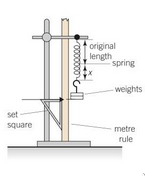 What does this photo show?
What does this photo show?Apparatus used to measure the extension of a spring.
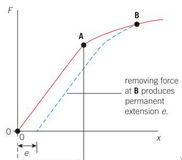 What does this graph represent?
Elastic and plastic deformation
What is the point at which a spring will become deformed called?
The elastic limit.
Why are elastic deformation and plastic deformation different?
Plastic deformation causes structural changes.
Hooke’s law and its formula
What is Hooke’s Law?
While the elastic limit of the spring is not exceeded, the extension of a spring is directly proportional to the force applied.
What does $k$ represent in the formula for Hooke’s Law, $F = kx$?
The force constant.
Simply put, what does the force constant $k$ represent in Hooke’s Law?
The stiffness of the spring.
If you have a force-extension graph, what does the gradient tell you?
The force constant of the spring.
Springs in series and parallel
Is it harder to extend springs to the same extension in series or parallel?
Parallel
What is the effective spring constant $k _ T$ for two springs connected in SERIES with $k _ 1$ and $k _ 2$?
What is the effective spring constant $k _ T$ for two springs connected in PARALLEL with $k _ 1$ and $k _ 2$?
Why is it harder to stretch two springs in parallel vs one spring to the same extension?
Because each spring in parallel only gets half the force.
Why is it easier to stretch two springs in series vs one spring to the same extension?
Because each spring in series gets the same force.
How do the springs in series and parallel formulas compare to the resistors in series and parallel formulas?
They are opposite ways round.
Defining Hooke’s law in an exam
How should you define Hooke’s law in an exam?
The extension of a wire or spring is directly proportional to the force applied, provided the limit of proportionality is not exceeded.
When stating Hooke’s law, what is proportional to what?
Extension is proportional to force.
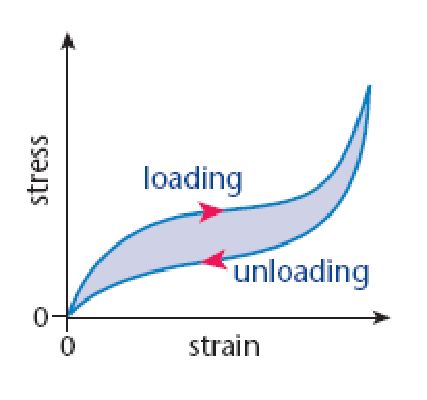
What are OCR finicky about when you’re describing elastic versus plastic materials?
They return to their same _ size _ , not _ shape _ .
Limit of proportionality vs elastic limit
 What is the difference between the limit of proportionality (A) and elastic limit (B)?
What is the difference between the limit of proportionality (A) and elastic limit (B)?The limit of proportionality is where they are no longer proportional, whereas the elastic limit is where it will still return to its original shape.
Describing materials and series-spring care
When describing a material from its stress-strain graph, what are some other options you should consider instead of “it obeys Hooke’s law”?
- Elastic
- Plastic
- Brittle
- Polymeric
Can you explain why the force constant of two identical springs of force constant $k$ connected in series have an effective force constant of $2k$?
The extension of each spring is halved because the force in each spring is halved, hence the force constant in $2k$.
When reading a question about springs in series or parallel, what do you have to be extra careful about?
Whether what you’re calculating applies to the system as a whole or just one spring.