Physics - Charge and Current
OCR A-Level Physics 2022
See also:
Current and its symbol
What are some examples of charged particles?
- Electrons, $e^{-}$
- Positrons, $e^{+}$
- Protons, $p$
- Ions, $Na^{+}$, $Cu^{++}$
Why is $I$ used to represent current?
Because it comes from the french “Intensity of Current”.
What does $1A$ mean physically?
1A is the same as 1 coulomb of charge passing a point in 1 second.
Electric charge
What is electric charge?
A physical property of matter which measures how charged something is.
What does $1C$ mean physically?
The charge that flows past a point in one second when there is a current of $1$ amp.
Charge of fundamental particles
Relative charge and the elementary charge
What is relative charge?
The measure of a charge as multiples of the constant $e$.
In relation to charge, what is the (non-numerical) definition of the constant $e$?
The elementary charge, the charge of a proton.
How can you work out the number of electrons given a charge $Q$?
Divide it by the elementary charge $e$, the charge contributed by each electron.
Gaining and losing electrons
If an object gains electrons, what happens to its charge?
It becomes negatively charged.
If an object loses electrons, what happens to its charge?
It becomes positively charged.
Conservation of charge
What is the law of conservation of charge?
Electric charge can neither be created nor destroyed.
Kirchhoff’s first law
What is word definition of Kirchhoff’s First Law?
At any point in an electrical circuit, the sum of the currents into that point is equal to the sum of the currents out of that point.
What is the symbol formula for Kirchhoff’s First Law?
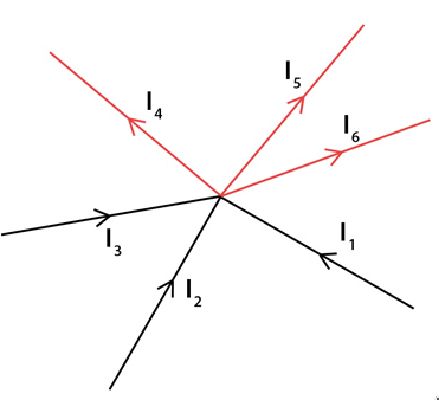 What must be true about the currents?
What must be true about the currents?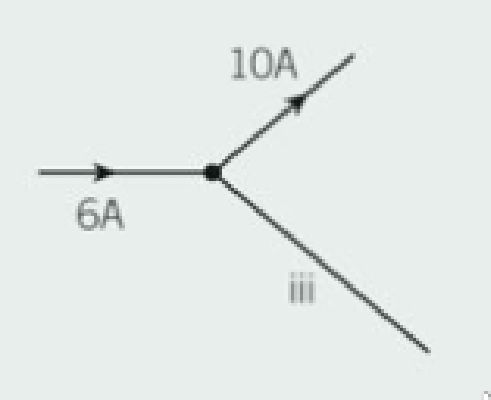 What is the missing current?
Ammeters
Examples of electric current
Why is electrolysis an example of electric current?
It’s the movement of ions.
Why are fluorescent tubes an example of electric current?
It’s the movement of a combination of electrons and ions.
Conventional current vs electron flow
Why do electrons go from negative to positive?
Because they are repelled by the negative side of a cell.
Why is the direction of conventional current opposite to the flow of electrons?
Negative particles moving one way is the same as positive particles flowing another way.
When referring to current, should you refer to conventional current or the flow of electrons?
The conventional current.