Physics - Archimedes' Principle
OCR A-Level Physics 2022
Archimedes’ principle and upthrust
What is Archimedes’ principle?
The upthrust on an object in a fluid is equal to the weight of fluid displaced.
Why submerged objects experience upthrust
In 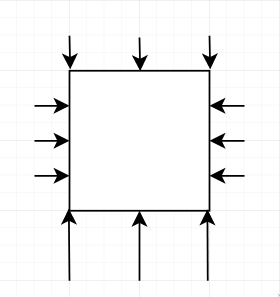 , why is there a resultant force upwards?
, why is there a resultant force upwards?Pressure increases with depth. There is more pressure on the bottom of the object.
In , why is there pressure on the sides?
, why is there pressure on the sides?Pressure is just particles bumping into the side, so particles bump into the side too.
Depth and height of a submerged object
Force from pressure over an area
What is the formula for the force of pressure $P$ over an area $A$?
What is the formula for the force of pressure at a height $h$ over an area $A$?
Deriving upthrust from top and bottom forces
In 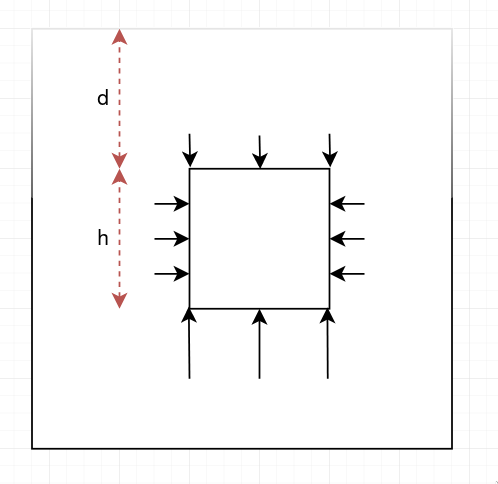 , what is the pressure at the top of the object if it has a surface area $A$?
, what is the pressure at the top of the object if it has a surface area $A$?In , what is the pressure at the bottom of the object if it has a surface area $A$?
, what is the pressure at the bottom of the object if it has a surface area $A$?In , if $\rho d g A + \rho h g A$ is the force at the bottom of the object and $\rho d g A$ is the force at the top, what is the resultant force?
, if $\rho d g A + \rho h g A$ is the force at the bottom of the object and $\rho d g A$ is the force at the top, what is the resultant force?In , the resultant force on the object is $\rho h g A$. How could you simplify this?
, the resultant force on the object is $\rho h g A$. How could you simplify this?Interpreting the upthrust equation
How can you think about the equation $\text{upthrust} = \rho g V$?
- $\rho V$ is the mass of the water displaced
- $\rho g V$ is the weight of the water displaced