Physics - Waves
OCR A-Level Physics 2022
Flashcards
Wave symbols
Defining wave quantities
What is the frequency of a wave?
The number of wavelengths passing through a given point per unit time.
What is the period of oscillation of a wave?
The time taken for a wave to move one whole wavelength past a given point.
What is the wavelength?
The distance between any point on a wave and the next identical point on an adjacent wave.
Wave equations
What is the wave equation, in terms of $v$, $f$ and $\lambda$?
What is the formula for frequency in terms of period $T$?
Types of wave
What is a transverse wave?
A wave where the oscillations are perpendicular to the direction of energy transfer.
What is a longitudinal wave?
A wave where the oscillations are parallel to the direction of energy transfer.
What is a mechanical wave?
A wave that requires a medium to travel through.
What is a wave that requires a medium to travel through called?
A mechanical wave.
What is special about electromagnetic waves?
They don’t require a medium to travel through.
What is the name for waves that don’t require a medium to travel through?
An electromagnetic wave.
In a longitudinal wave, what’s one way you could measure the wave length?
Find the distance between a pair of compressions/rarefactions.
What is the main difference between transverse and longitudinal waves?
In a transverse wave, oscillations are perpendicular to energy transfer whereas they are parallel in a longitudinal wave.
Since transverse and longitudinal waves are both progressive waves, what must be true?
They both transfer energy but not matter.
Wave diagram features
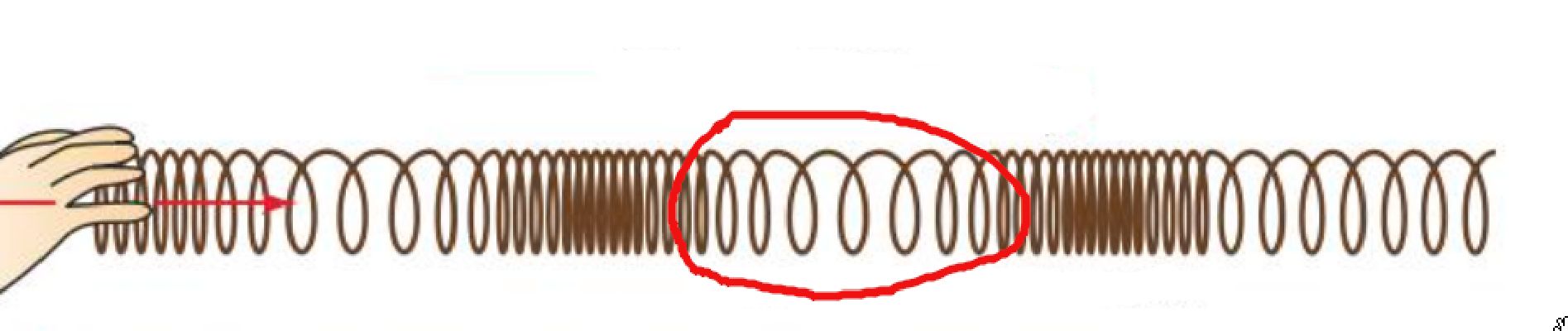 What is this called?
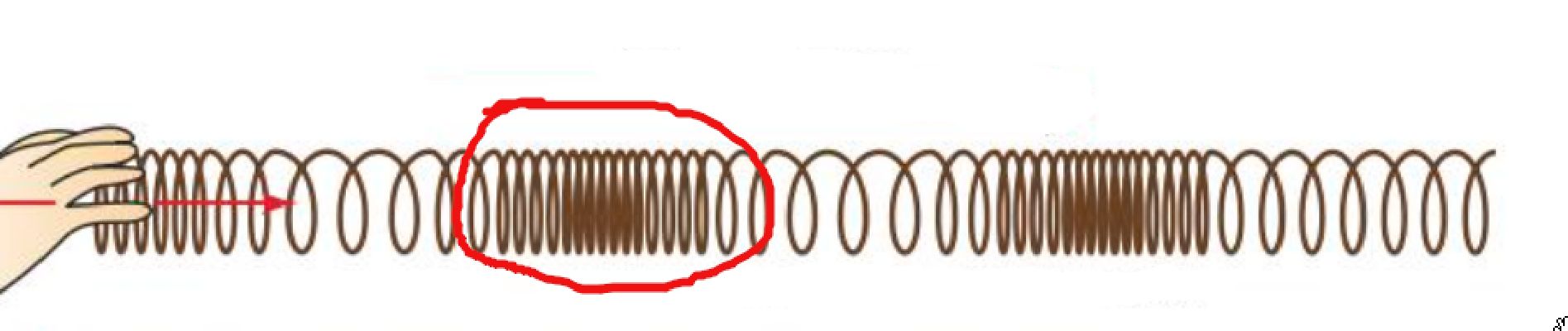 What is this called?
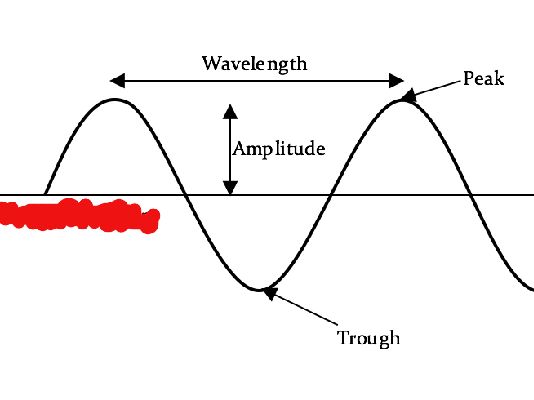 What is missing?
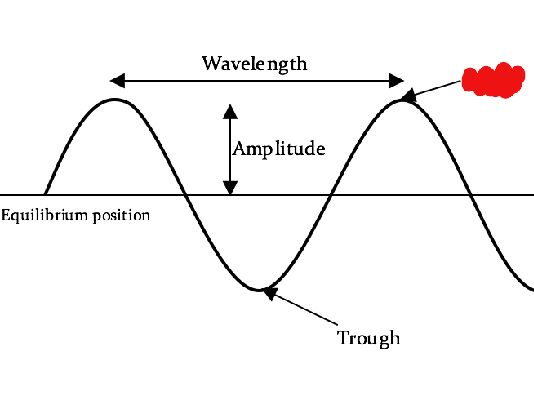 What is missing?
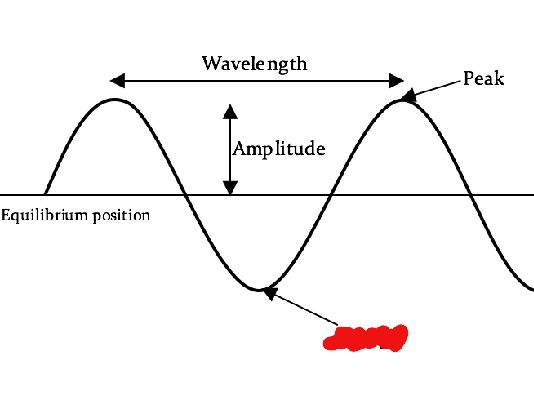 What is missing?
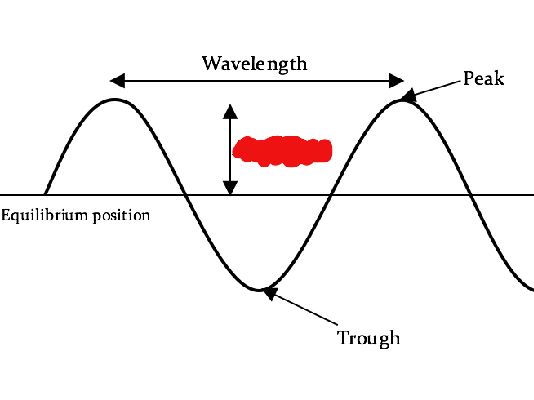 What is missing?
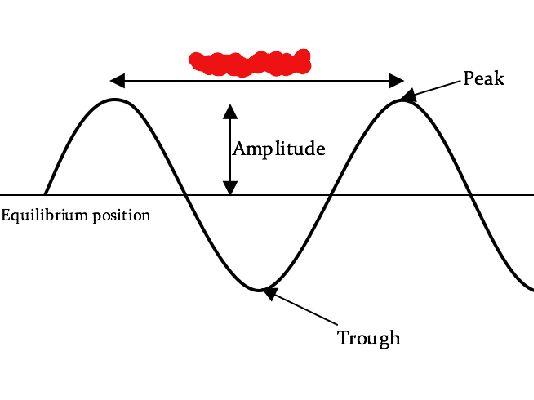 What is missing?
Wave profiles and graphs
On a displacement-distance graph, what does the distance between two troughs equal?
The wavelength.
On a displacement-time graph, what does the time between two troughs equal?
The period.
Phase
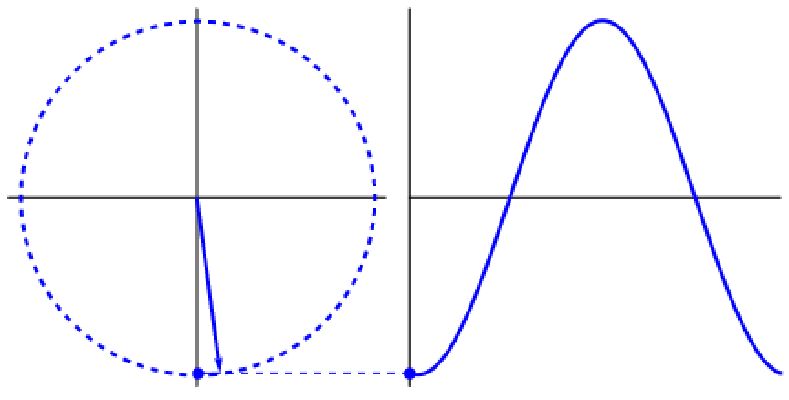 How does the angle the radius makes with the circle relate to the wave?
How does the angle the radius makes with the circle relate to the wave?That’s the phase of the point on the wave.
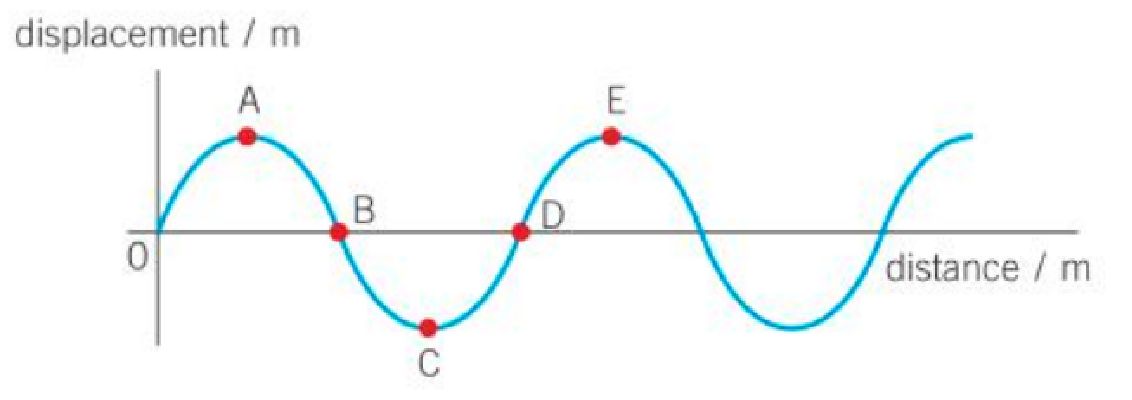 What is the phase difference between $A$ and $E$?
What does it mean for two particles to be “in phase”?
They are oscillating perfectly in step with each other.
What does it mean for two particles being “in antiphase”?
They are oscillating perfectly out of step with each other.
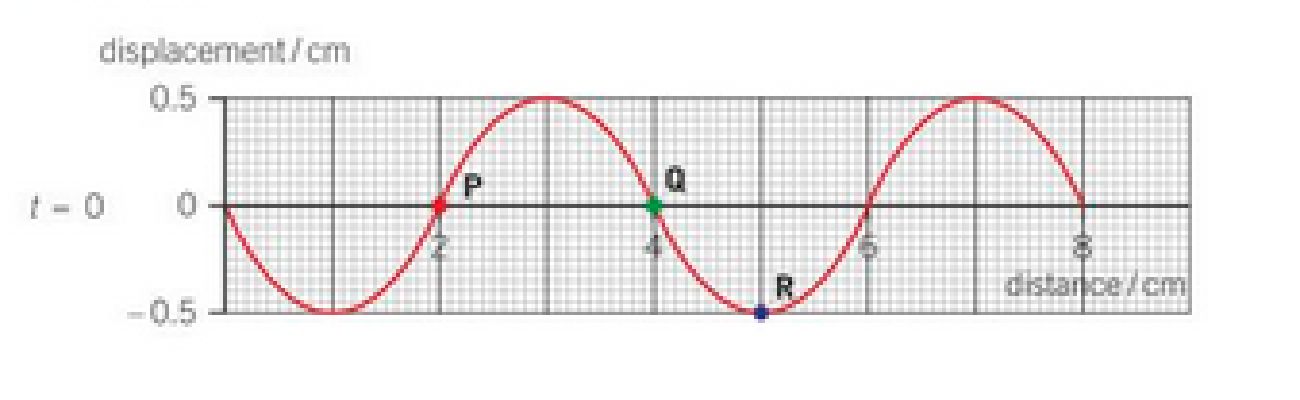 What would the wave profile for $T - \frac{T}{2}$ look like?
What’s the formula for $\phi$, the phase difference in degrees between two points on a wave of wavelength $\lambda$ and separated by a distance $x$?
Colour and wavelength
Superposition
What is the principle of superposition of waves?
Displacement of a wave is equal to the sum of the displacements of the individual waves.