Further Maths - Vector Equation of a Plane
Pearson Edexcel Further Mathematics 2022
The parametric equation of a plane
What is the general vector equation of a plane?
\[\pmb{r} = \pmb{a} + \lambda\pmb{b} + \mu\pmb{c}\]
What must be true about the two directional vectors $\pmb{b}$ and $\pmb{c}$?
They are not parallel to one another.
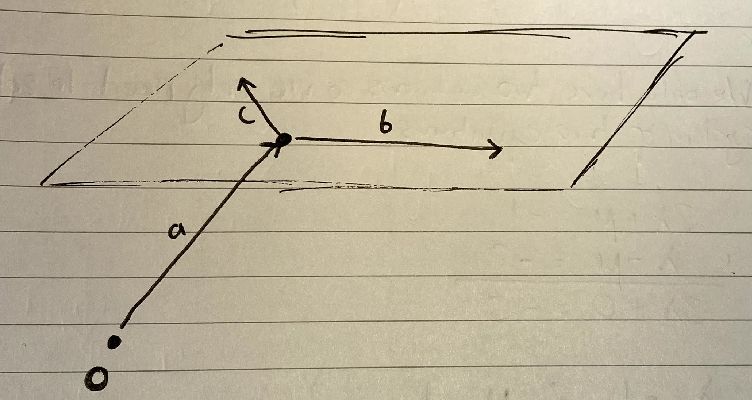 What equation does this photo represent?
What equation does this photo represent?Testing whether a point lies on a plane
\[ \left(\begin{matrix} 3+2\lambda+\mu \\ 4+\lambda-\mu \\ -2+\lambda+2\mu \end{matrix}\right) = \left(\begin{matrix} 2 \\ 2 \\ -1 \end{matrix}\right)\]
How could you rewrite this?
\[ \left(\begin{matrix} 2\lambda+\mu \\\\ \lambda-\mu \\\\ \lambda+2\mu \end{matrix}\right) = \left(\begin{matrix} -1 \\\\ -2 \\\\ 1 \end{matrix}\right) \]
Why do you only need to solve two equations rather than all three?
There are only two unknowns.
\[ \left(\begin{matrix} 2\lambda+\mu \\\\ \lambda-\mu \\\\ \lambda+2\mu \end{matrix}\right) = \left(\begin{matrix} -1 \\\\ -2 \\\\ 1 \end{matrix}\right) \]
If this system of equations has a solution, what does it mean?
A point lies on the plane.
Building a plane from three points
If there are three points $A, B, C$ on a plane, what vectors could you also say are on the plane?
- $\overrightarrow{AB}$
- $\overrightarrow{AC}$
- $\overrightarrow{BC}$
If there are three points $A, B, C$ on a plane, how could you write the plane equation?
The Cartesian equation of a plane
What is the general form of the Cartesian equation of a plane?
What’s the intuition for $ax + by + cz = d$?
It tests points; given an $(x, y, z)$ you can check if it’s on the plane.
\[2x + 3y + 5z = 5\]
What is the normal vector to the plane?
\[ \left(\begin{matrix} n _ 1 \\ n _ 2 \\ n _ 3 \end{matrix}\right) \]
What’s the Cartesian equation of the plane if $n$ is the normal vector?
Given the start of the Cartesian equation for a plane $ax + by + cz$ and a point on the plane, how can you work out the Cartesian equation of the plane?
Substitute the point into the equation and set it equal to the result.
Coplanar points
What does it mean for points to be coplanar?
All the points lie on the same plane.
How could you prove that points are coplanar?
Come up with a plane equation using 3 of the points and use it to test the other ones.
The three forms of a plane equation
What does the parametric equation of a plane look like?
What does the scalar product equation of a line look like?
What are the three types of plane equation?
- Cartesian
- Parametric
- Scalar product
Deriving the scalar product form
Is the normal vector a plane a position of a direction vector?
A direction vector.
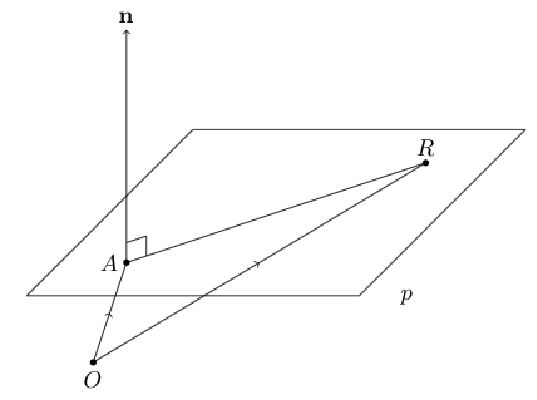 What does $R$ represent here?
What does $R$ represent here?The general position vector of a point on the plane.
What’s true about the line $\pmb{r} - \pmb{a}$ in relation to the normal vector $\pmb{n}$?
What’s true about the line $\pmb{r} - \pmb{a}$ in relation to the normal vector $\pmb{n}$?It is perpendicular.
How would you write $\pmb{r} - \pmb{a}$ being perpendicular to the normal vector $\pmb{n}$?
How would you write $\pmb{r} - \pmb{a}$ being perpendicular to the normal vector $\pmb{n}$?Expand
\[\pmb{n}(\pmb{r} - \pmb{a}) = 0\]
?
\[\pmb{r}\cdot\pmb{n} - \pmb{a}\pmb{n} = 0\]
How could you rewrite this?
\[\pmb{r}\cdot\pmb{n} = \pmb{a}\cdot\pmb{n}\]
How does $\pmb{a}\cdot\pmb{n}$ relate to the Cartesian equation of the plane?
It’s what the Cartesian equation is equal to.
\[ \pmb{r}\cdot\pmb{n} = d \]
How could you rewrite this to show that the normal vector contains the coefficients of the Cartesian equation of the plane?
Angle between two planes
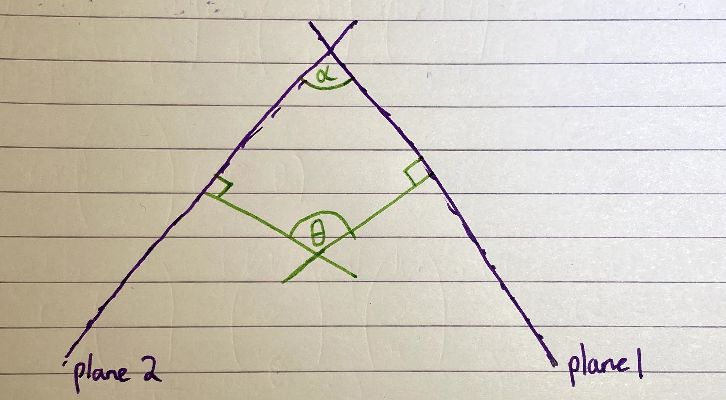 If the angle between the normals of two intersecting lines is $\theta$, what is the angle between the two intersecting planes?
If the angle between the normals of two intersecting lines is $\theta$, what is the angle between the two intersecting planes? If the two normals are $\pmb{n _ 1}$ and $\pmb{n _ 2}$, what’s the formula for $\cos\theta$?
If the two normals are $\pmb{n _ 1}$ and $\pmb{n _ 2}$, what’s the formula for $\cos\theta$?\[\pmb{r}\cdot\pmb{n _ 1} = k _ 1 \\ \pmb{r}\cdot\pmb{n _ 2} = k _ 2\]
What is the formula for $cos\theta$, the angle between the two intersecting planes?
Angle between a plane and a line
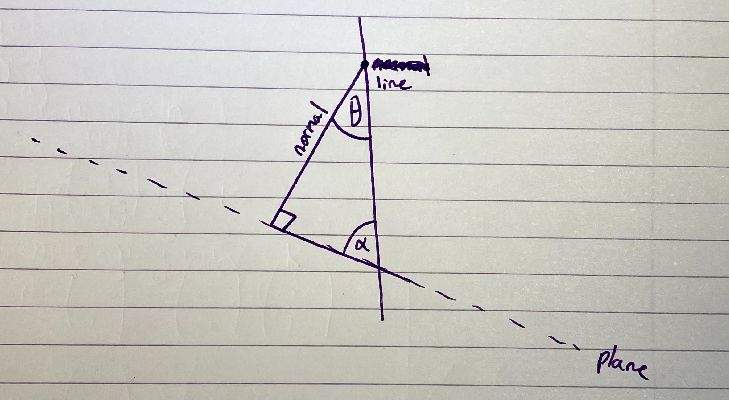 If the angle between the line and the normal to the plane is $\theta$, what is the angle between the plane and the line?
If the angle between the line and the normal to the plane is $\theta$, what is the angle between the plane and the line?\[\pmb{r}\cdot\pmb{n} = k \\ \pmb{r} = \pmb{a} + \lambda\pmb{b}\]
What is the formula for $sin\theta$, the angle between the intersecting plane and line?
\[\pmb{r}\cdot\pmb{n} = k \\ \pmb{r} = \pmb{a} + \lambda\pmb{b}\]
What is the formula for $sin\theta$, the angle between the intersecting NORMAL TO THE plane and line?
Why do you use $\sin$ rather than $\cos$ to tell you the angle between the intersecting plane and line?
Why do you use $\sin$ rather than $\cos$ to tell you the angle between the intersecting plane and line?Because $\cos\theta$ is the angle between the line and the normal, so $\sin\theta$ is $90 - \theta$.
Parallel planes
What is true about the plane equations for parallel planes?
Their normal vectors are the same.
Distance and reflection
Given a point $(\alpha, \beta, \gamma)$ and a plane $ax + by + cz = d$, what’s the formula for the shortest distance from the point to the plane?
When a plane is defined as $r\cdot\pmb{\hat{n}} = k$, what does $k$ represent?
The length of the perpendicular from the origin to the plane.
What’s the general technique for finding a point $P$ reflected across a plane $\Pi$?
$P$ must lie on a line perpendicular to plane at some point $M$. You can then travel backwards the same amount to get to the other side.