Further Maths - Polar Coordinates
Pearson Edexcel Further Mathematics 2022
Flashcards
Cartesian and polar conversions
$r = a\cos n\theta$
\[r = a\cos\theta\]
How would you describe IN WORDS what this look like?
A circle along the $x$-axis starting at the origin and ending after a diameter $a$ long.
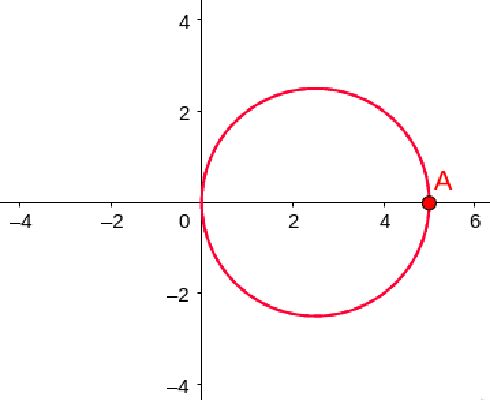 What is the general polar equation for curves that look like this?
What is the general polar equation for curves that look like this?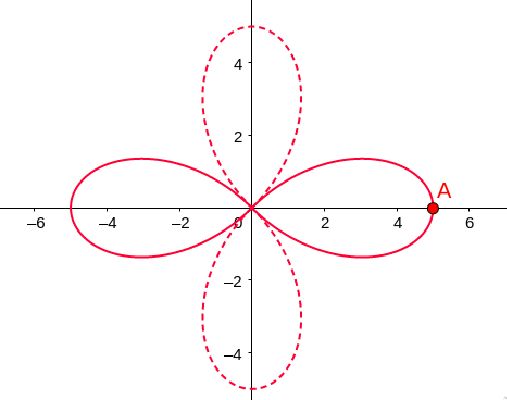 What is the general polar equation for curves that look like this?
What is the general polar equation for curves that look like this?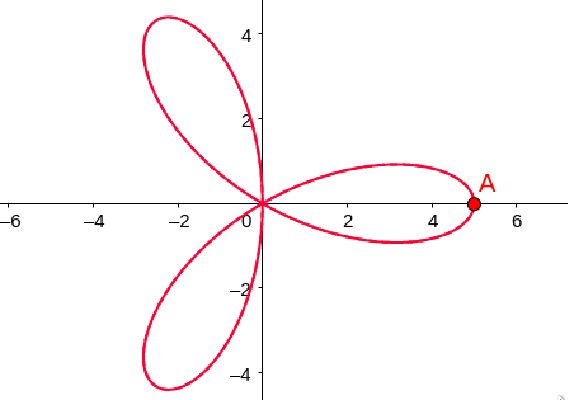 What is the general polar equation for curves that look like this?
What is the general polar equation for curves that look like this?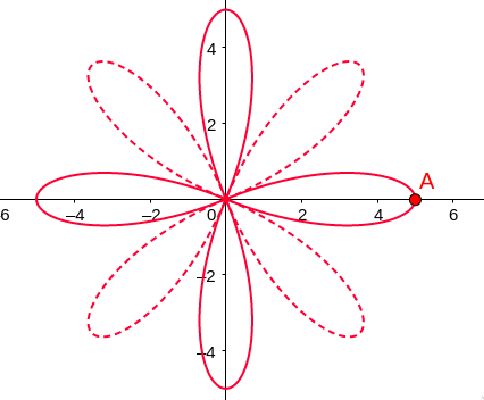 What is the general polar equation for curves that look like this?
What is the general polar equation for curves that look like this?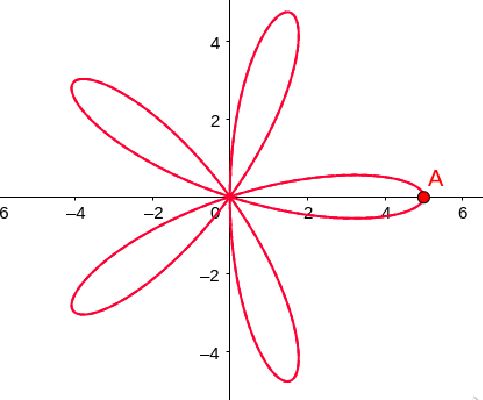 What is the general polar equation for curves that look like this?
What is the general polar equation for curves that look like this?$r = a\sin n\theta$
\[r = a\sin\theta\]
How would you describe IN WORDS what this look like?
A circle along the $y$-axis starting at the origin and ending after a diameter $a$ long.
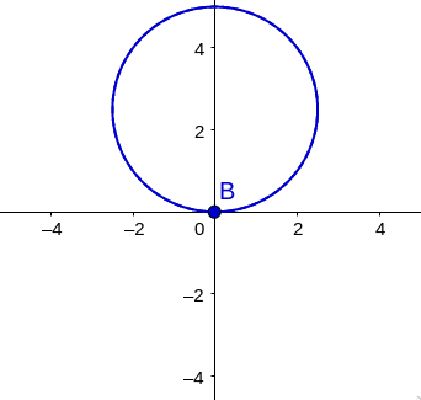 What is the general polar equation for curves that look like this?
What is the general polar equation for curves that look like this?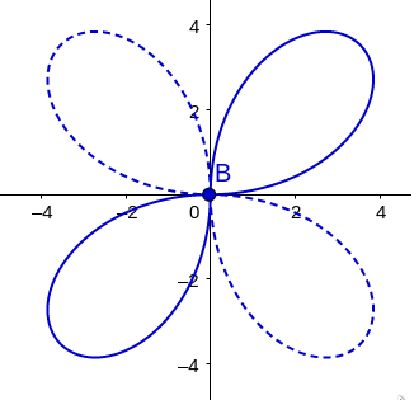 What is the general polar equation for curves that look like this?
What is the general polar equation for curves that look like this?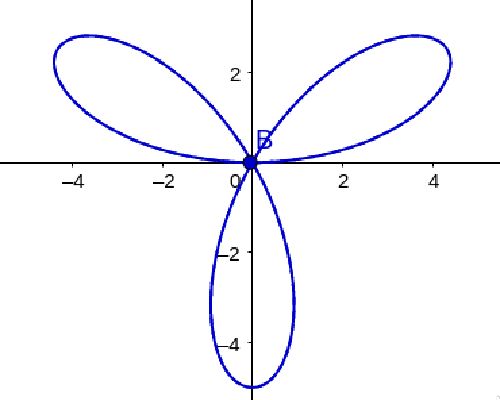 What is the general polar equation for curves that look like this?
What is the general polar equation for curves that look like this?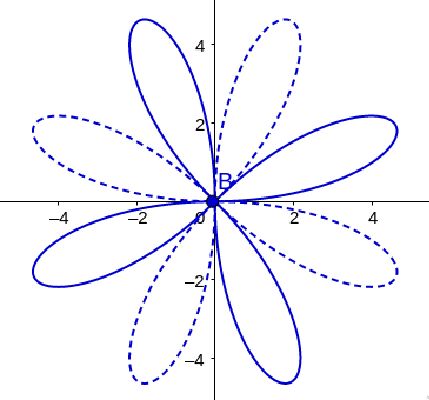 What is the general polar equation for curves that look like this?
What is the general polar equation for curves that look like this?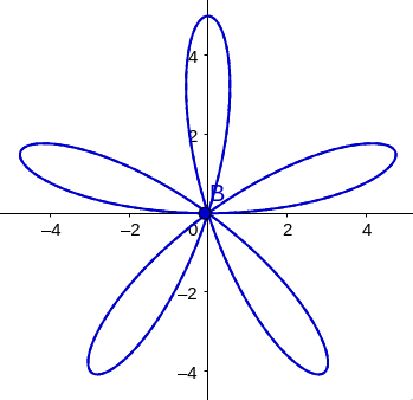 What is the general polar equation for curves that look like this?
What is the general polar equation for curves that look like this? What do the dashed lines represent here?
What do the dashed lines represent here?Where the polar equation gives negative results.
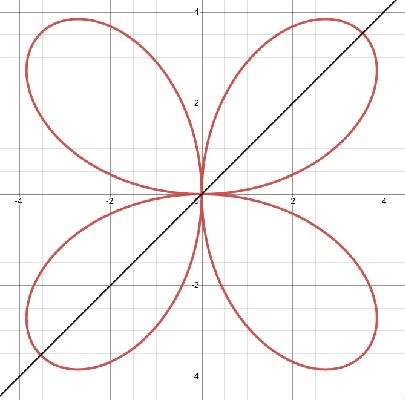 Where would you expect the maximum “bump” to start for a polar equation $r = a\sin n\theta$?
Where would you expect the maximum “bump” to start for a polar equation $r = a\sin n\theta$?Cardioids
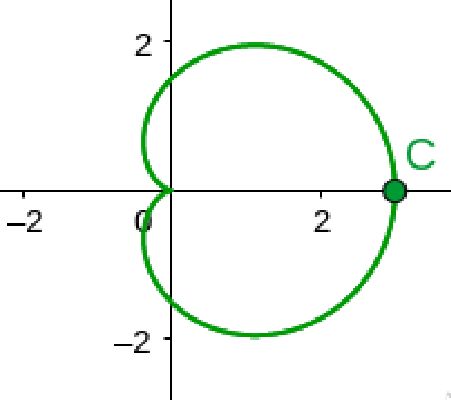 What is the name for shapes like these?
\[r = a + b\cos\theta\]
What does this polar graph look like, for $a = \vert b \vert $?
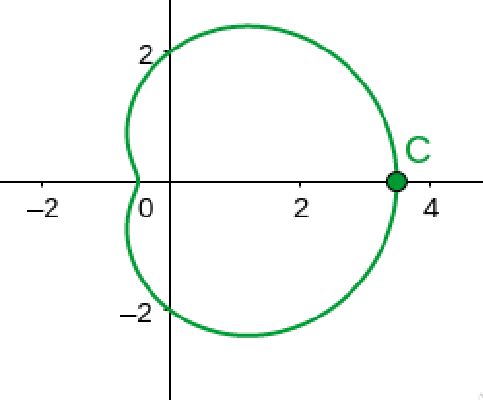
\[r = a + b\cos\theta\]
What does this polar graph look like, for $a > \vert b \vert $?
\[r = a + b\sin\theta\]
What does this polar graph look like, for $a = \vert b \vert $?
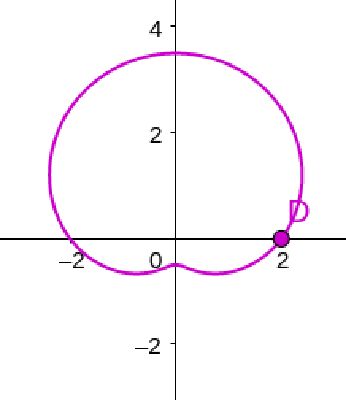
\[r = a + b\sin\theta\]
What does this polar graph look like, for $a > \vert b \vert $?
Area by integration
Given a polar equation
\[r = ...\]
what is the formula for the area between angles $\alpha$ and $\beta$?
Where does the polar integration formula
\[\frac{1}{2} \int^\alpha _ \beta r^2 d\theta\]
come from?
The formula for arc area, $\frac{1}{2}r^2\theta$
Why do you have to be careful picking limits to find the area of one loop of this curve?
Why do you have to be careful picking limits to find the area of one loop of this curve?Because you would’ve thought you could pick $\pi/2$ and $-\pi/2$ but you actually have to use the closest tangent so you don’t include unnecessary area.
Tangents and parametric form
\[x = r\cos\theta\]
\[y = r\sin\theta\]
Given that $r = \cos\theta$ what is the parametric form of the polar equation with parameter $\theta$?
If
\[\frac{\text{d}x}{\text{d}\theta} = 0\]
what is true about a polar curve for that value of $\theta$?
It is perpendicular to the initial line ($\theta = 0$).
If
\[\frac{\text{d}y}{\text{d}\theta} = 0\]
what is true about a polar curve for that value of $\theta$?
It is parallel to the initial line ($\theta = 0$).